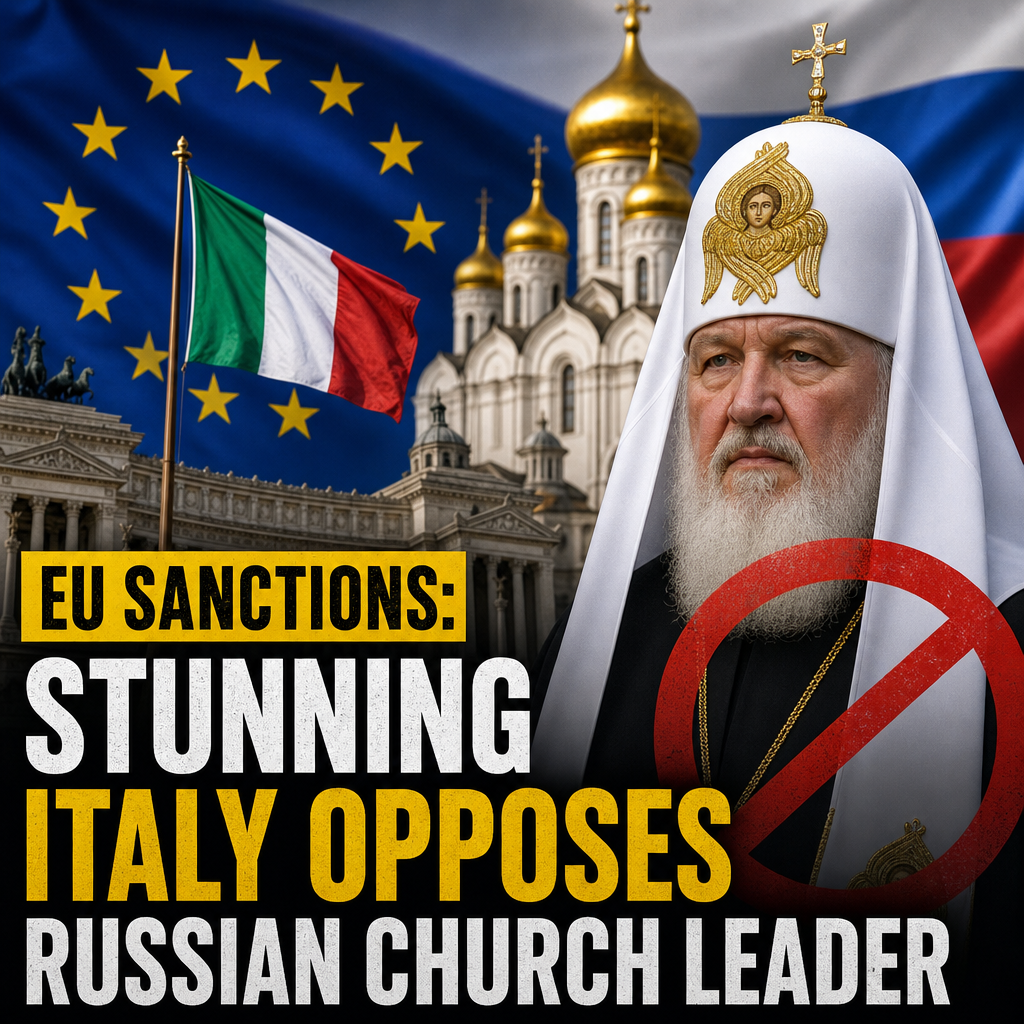
EU Sanctions: Stunning Italy Opposes Russian Church Leader


EU Sanctions have once again exposed a familiar fault line inside Europe: how far the bloc should go when punishing figures tied to Russia’s war effort, especially when religion, politics, and diplomacy overlap.
Italy’s reported opposition to sanctioning a senior Russian church leader has added a fresh layer of complexity to the EU’s wider debate over Moscow. At stake is not just one name on a sanctions list, but a broader question about whether European measures should target symbolic figures seen as supporting the Kremlin, or stay narrowly focused on military, financial, and industrial assets. The disagreement matters because EU sanctions are only as strong as the political consensus behind them.



EU Sanctions and the Politics of Religious Figures
The controversy centers on the long-running discussion over whether a top Russian Orthodox leader should be included in EU punitive measures. Supporters of such a move argue that some religious authorities have not remained neutral during the war in Ukraine. They point to public statements, institutional backing, and ideological alignment that, in their view, help legitimize Russia’s aggression and reinforce the Kremlin’s message.
From that perspective, sanctions are not just about economics. They are also about pressure, symbolism, and isolating networks that support the war. Brussels has already shown a willingness to expand restrictions beyond soldiers and oligarchs, targeting media outlets, banks, and other instruments of state influence. Those in favor of sanctioning a church leader say the logic is consistent: if an influential public figure helps sustain the war narrative, the EU should respond.




But Italy’s reported resistance reflects a different concern. Governments wary of extending sanctions into the religious sphere argue that such moves can blur the line between political accountability and freedom of belief. Even if a church leader is politically aligned with the Kremlin, critics of the measure say the EU should be careful about appearing to punish religion itself, rather than specific conduct. That distinction is important in European politics, where governments are often sensitive to accusations that sanctions are drifting from principle into symbolism.
There is also a practical concern. Sanctions work best when they are targeted, defensible, and backed by all member states. The more expansive or morally loaded the target, the more likely it is that unity will fracture. Italy’s stance suggests that, at least in some capitals, there is a preference for keeping sanctions focused on directly measurable instruments of war rather than figures whose influence is real but harder to quantify.
Why some EU states want limits
Several arguments appear to be shaping the more cautious camp:
– Sanctions should hit financial and military enablers first.
– Religious figures are harder to classify as direct actors in the conflict.
– Expanding sanctions too far may weaken the EU’s moral credibility.
– A split over symbolic targets can slow or dilute broader punitive packages.
That caution does not necessarily mean sympathy for Moscow. Instead, it reflects a belief that sanction policy must remain credible and legally durable. If the EU appears to overreach, opponents may challenge the measures in courts or use them for propaganda, claiming Europe is hostile to Russian identity or faith more broadly.
What the dispute says about Europe’s Russia strategy
The reported Italian objection also highlights a deeper truth: Europe remains united in condemning Russia’s invasion, but not always united on how to express that condemnation. Some governments see sanctions as a tool to widen pressure in every direction possible. Others believe overuse can make the tool less effective.
That tension has surfaced repeatedly since the start of the war. EU states have agreed on major rounds of sanctions, but only after difficult negotiation over energy, banking, and export controls. Every package involves a balancing act between punishing Moscow and protecting European interests. The current dispute shows that the same balancing act now extends to reputational and cultural targets too.
From a human perspective, this debate is also uncomfortable because it intersects with religion. Churches are often treated as moral institutions, yet in Russia’s case the Orthodox hierarchy has been widely accused by critics of becoming too closely entangled with state power. Supporters of sanctions on the church leadership see that as precisely why such figures should be held accountable. Opponents counter that punishing a religious leader could create more questions than answers, especially if it sets a precedent the EU would rather avoid.
A fair reading of the situation is that neither side is entirely wrong. Those pushing for sanctions are responding to a real pattern: influential institutions can help normalize war. Those resisting are also responding to a real risk: sanctions that move too far into symbolic territory can become inconsistent, politicized, or counterproductive.
What seems clear is that the EU is still trying to define the outer limits of its response to Russia. If the bloc wants to maintain unity, it may need to draw a sharper line between individuals who directly facilitate war and those whose role is more indirect, even if politically significant. But if it draws that line too narrowly, it risks leaving out figures whose influence helps sustain the very system Europe wants to weaken.
For now, Italy’s reported opposition does not look like a collapse of European resolve. It looks more like a reminder that sanctions are not just a legal instrument—they are a political statement. And on Russia, Europe is still debating exactly what that statement should be.